
Inside the evolution of the U.S. Navy’s most enduring strategic shield
For seventy years, a silent and powerful presence has existed beneath the world’s oceans—one that never seeks attention yet remains central to global stability. U.S. Navy ballistic missile submarines, the most discreet component of America’s nuclear triad, patrol the depths in near-total secrecy. Their mission is straightforward yet profound: ensure that no adversary can contemplate a strategic attack without facing certain and overwhelming retaliation. This underwater deterrent, supported by the Fleet Ballistic Missile (FBM) program and its industry partners, has quietly shaped international security for nearly three-quarters of a century.
The roots of this remarkable capability stretch back to the dawn of the Cold War. Since the first successful Polaris missile launch from the USS George Washington in 1960, the FBM program has continually strengthened the U.S. Navy’s sea-based deterrence mission, evolving through generations of technological breakthroughs. Lockheed Martin, the primary industry steward of the program since its inception, has marked this year as a 70-year milestone—one defined by innovation, partnership, and unwavering commitment.
“Lockheed Martin has proudly supported the Fleet Ballistic Missile program for 70 years,” said Eric Scherff, vice president of Lockheed Martin’s Fleet Ballistic Missile Program. “As we celebrate this milestone with our Navy partners, we build on decades of experience and dedication, and we will continue building that legacy of innovation to preserve strong deterrence and deliver peace through strength.”
A Vision Born in Crisis
The origins of the FBM program can be traced to a decisive moment in 1955. With nuclear tensions escalating and geopolitical uncertainties rising, Adm. Arleigh Burke—then Chief of Naval Operations—tasked Rear Adm. William “Red” Raborn with an unprecedented challenge: develop a nuclear deterrent that could avoid a first strike, remain hidden from adversaries, and launch without warning from beneath the waves.
Reliability was essential. Stealth was mandatory. Speed was non-negotiable.
“The Navy needed a capability that would protect our homeland, aid our allies, deter adversaries, and give leaders valuable time to avoid conflict,” Scherff explained. Meeting such requirements demanded more than simply improving existing weapons—it required revolutionary advances in propulsion, guidance systems, underwater launch engineering, and materials science.
Many experts believed the task impossible. Nevertheless, Lockheed—then known as Lockheed Aircraft Company—accepted the risk, winning the first contract in December 1955. With rapid development underway, engineers, scientists, and naval innovators worked tirelessly, compressing what could have been decades of effort into just a few high-pressure years.
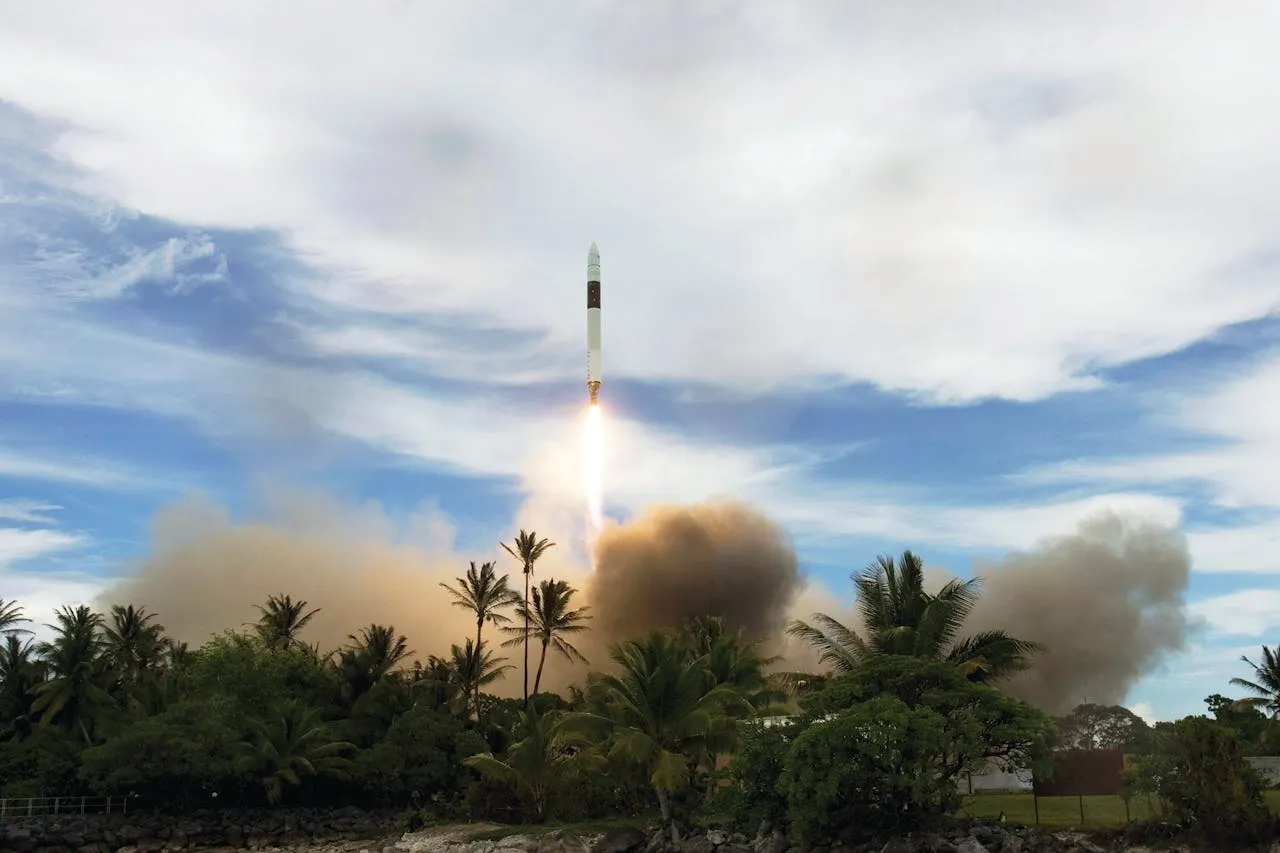
Their determination paid off in July 1960, when the Polaris A1 missile was successfully fired from beneath the ocean’s surface by the USS George Washington. This historic test proved that a submarine-launched ballistic missile (SLBM) could be deployed covertly, instantly transforming naval strategy and global deterrence.
Building a Long-Term Engineering Powerhouse
The Polaris breakthrough launched more than a missile—it launched an enduring engineering enterprise. Lockheed soon established a permanent missile development facility in Sunnyvale, California. That campus became a nucleus for decades of research and development, later expanding into a nationwide network of specialized labs, testing ranges, production sites, and technology centers.
Each of the six major FBM missile generations introduced major breakthroughs:
- Polaris A1 – demonstrated the world’s first successful submerged missile launch
- Polaris A3 – introduced multiple reentry vehicles, enabling one missile to engage multiple targets
- Poseidon C3 – enhanced accuracy, reliability, and payload capacity
- Trident I C4 – extended mission range, providing true global reach
- Trident II D5 – set new benchmarks for precision, survivability, and strategic deterrence
- Trident II D5 Life Extension (D5LE) – refreshed guidance, avionics, and components to ensure operation well into the 2040s
“Every new generation of deterrence systems we deliver is a proactive step to stay ahead,” said Scherff. “We’ve never stopped adapting and we never will.”
This long evolution has been made possible not only by Lockheed Martin’s internal expertise, but also by a broad ecosystem of suppliers—companies specializing in advanced materials, electronics, precision machining, propulsion engineering, and digital software innovation. According to Scherff, these relationships “amplify our engineering capabilities and keep the FBM system at the forefront of reliability and innovation.”
Deterrence in an Era of New Threats
While the Cold War provided the original backdrop for the FBM program, today’s strategic environment is more complex and unpredictable. By 2025, multiple nations are rapidly modernizing nuclear forces, developing hypersonic weapons, expanding undersea capabilities, and strengthening cyber tools aimed at critical military infrastructure.
In such an environment, a survivable and stealthy deterrent is more essential than ever.
Ballistic missile submarines, operating silently around the world, remain virtually undetectable. Their invisibility creates a form of deterrence that relies not on visibility but on uncertainty. No adversary can ever be confident that a first strike would prevent a devastating counterattack.
“Because this system can’t be seen, it forces our adversaries to plan for a threat they can’t detect,” Scherff said. “That’s the ultimate insurance policy. It works not by using force, but by making the cost of aggression too great.”
The logic is simple but powerful: every day an adversary decides not to initiate conflict is a day deterrence has succeeded.
From Pencil Drafts to Digital Twins
Few individuals understand the program’s evolution better than Charlie Barndt, who joined the FBM effort in 1967. Beginning as a training instructor, Barndt moved through a range of engineering roles, eventually shaping system-level architecture and safety standards. He recalls a time when every component began as a hand-drawn sketch and hardware was built and tested manually, relying heavily on the ingenuity and discipline of the engineers behind it.
“Every line on a drawing has to survive the toughest safety analysis, and that mindset has shaped the whole program,” Barndt said.
One of the highlights of his career was collaborating with the United Kingdom’s Ministry of Defence on strengthening propulsion management through the D5 Performance Evaluation Missile (PEM) upgrade. The project demonstrated how two nations, separated by oceans, could come together under shared principles of technical rigor and safety.
Over the decades, as tools advanced from blueprint drafting tables to digital engineering platforms, the program embraced technologies such as digital twins, model-based systems engineering, and AI-enabled verification systems. These tools allow for faster development, earlier identification of issues, and more precise validation—without compromising the program’s longstanding culture of caution and thoroughness.
“The tools have changed, but the discipline of designing for longevity and survivability stays the same,” Barndt emphasized.
A Partnership Built on Trust
For seventy years, Lockheed Martin and the U.S. Navy have collaborated on one of the most complex and consequential engineering endeavors on Earth. Barndt attributes the longevity of this partnership to three foundational values: a mission-first mindset, a commitment to transparent data sharing, and a shared dedication to delivering reliable systems to the warfighter.
This trust has allowed the partnership to continually innovate while ensuring that safety and reliability remain uncompromised.
Today, the next era of sea-based deterrence is taking shape. Lockheed Martin is leading the development of the Trident II D5 Life Extension 2 (D5LE2) missile and the next-generation Mk7 reentry system, both designed to support the U.S. Navy’s future Columbia-class ballistic missile submarines and sustain deterrence well into the 2080s.
“In many ways it feels like 1955 again,” Scherff said. “We are racing against the clock, innovating fast, and building something that will serve the next generation the way Polaris, Poseidon, and Trident served ours.”
Sixty-five years after the first Polaris missile rose from beneath the ocean’s surface, the fundamental purpose of the FBM system remains unchanged: to act as a powerful deterrent designed to be seen in tests, not in conflict. Each successful flight test serves as both validation and reassurance—proof that the system is ready, and a reminder to adversaries that aggression carries unacceptable risk.
“This is a legacy of peace through strength,” Scherff said. “We are honored to carry it forward for the next six decades and beyond.”
Source link: https://www.lockheedmartin.com/