

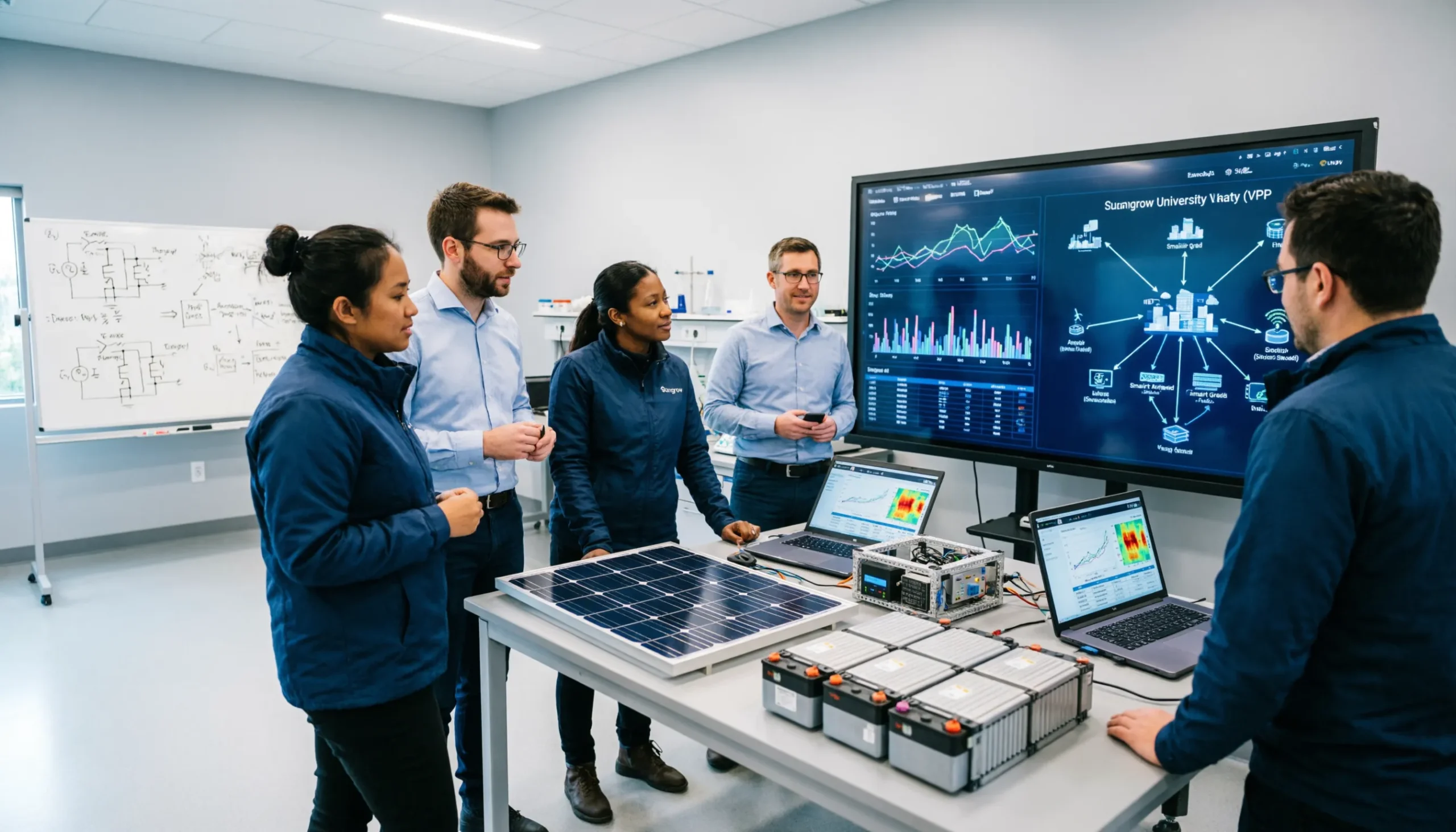
Introduction to the Collaborative Energy Storage Initiative
Sungrow, a globally recognised provider of photovoltaic inverters and energy storage technologies, has successfully implemented a hybrid battery energy storage solution through a strategic collaboration with the University of New South Wales (UNSW) and Dubbo Regional Council. This initiative has been designed to support advanced experimentation and deployment of Energy Management Systems (EMS) and Virtual Power Plant (VPP) technologies within a real-world operational environment. By combining industry-grade hardware, academic research capability, and municipal infrastructure, the project establishes a practical demonstration platform that accelerates the transition from theoretical innovation to scalable clean-energy deployment. The installation not only strengthens research outcomes for UNSW’s Energy Team but also contributes directly to Dubbo Regional Council’s long-term sustainability, operational efficiency, and energy resilience objectives, creating measurable community value while advancing Australia’s broader clean-energy transformation.
Project Structure, Stakeholders, and Funding Framework
Within the project framework, Sungrow served as the exclusive equipment supplier, ensuring the deployment of advanced hybrid battery systems engineered for intelligent coordination and stable performance. UNSW assumed the role of engineering and research lead, overseeing system design, EMS development, and validation of VPP-ready operational logic. Dubbo Regional Council became the system owner and host site, integrating the solution into the Council building’s existing energy infrastructure and enabling real-time operational testing in a live municipal setting. Financial support for the initiative was provided through TRaCE, the Trailblazer for Recycling and Clean Energy program established under the Australian Department of Education to accelerate the translation of university-driven innovation into commercially viable and community-ready technologies. Commencing in the first quarter of 2025 and now completed, the project demonstrates how coordinated funding, academic leadership, and industry execution can shorten the pathway from research to deployment while delivering immediate functional benefits to public infrastructure.
Technical Architecture and Intelligent System Composition
At the core of the installation is a carefully engineered hybrid energy storage configuration consisting of two Sungrow SH15T/SBH300 systems operating in coordinated alignment through a Logger1000 communication and control interface. This architecture enables unified monitoring, synchronised battery behaviour, and streamlined interaction with UNSW’s EMS platform, ensuring that performance optimisation occurs continuously across the full energy ecosystem. The system has been AC-coupled to the building’s pre-existing solar photovoltaic array, allowing seamless integration without disruption to established solar generation processes or electrical stability. Such an approach demonstrates the viability of upgrading legacy renewable infrastructure with advanced storage and control intelligence rather than requiring full system replacement, significantly improving cost efficiency and deployment flexibility for future municipal or commercial installations.
Advanced Control, Monitoring, and Predictive Optimisation Capabilities
A defining characteristic of the project is the sophisticated operational intelligence enabled by UNSW’s EMS, which governs the entire configuration through a single logging and coordination point. This unified control environment allows for real-time load monitoring, automated demand-side management, and predictive optimisation informed by weather forecasting data, occupancy behaviour, and consumption trends. Through these capabilities, the system can anticipate energy demand fluctuations, adjust storage dispatch accordingly, and minimise reliance on grid electricity during peak pricing periods. The coordinated operation of Sungrow’s hybrid batteries ensures stability, reliability, and efficiency while maintaining readiness for expanded VPP participation. Such intelligent orchestration illustrates how digital energy management can transform static renewable installations into responsive, data-driven energy ecosystems capable of delivering both economic and environmental performance improvements.
Bridging Academic Research with Practical Community Outcomes
One of the most significant achievements of the initiative lies in its successful translation of academic research into tangible operational value for a regional Australian community. By integrating Sungrow’s commercial-grade battery technology with UNSW’s evolving EMS algorithms, the installation enables simultaneous behind-the-meter and front-of-the-meter functionality, thereby supporting both local energy optimisation and broader grid interaction potential. For Dubbo Regional Council, this translates into reduced operational energy costs, improved resilience against supply disruptions, and enhanced sustainability performance across municipal facilities. For UNSW researchers, the site functions as a living laboratory where real-time operational data can validate theoretical models, refine predictive control strategies, and accelerate the industrial readiness of next-generation EMS and VPP solutions. This dual-benefit structure exemplifies how collaborative clean-energy projects can generate immediate public value while advancing long-term technological progress.
Economic Sustainability and Community Impact
Dubbo Regional Council leadership has emphasised the direct financial and social advantages associated with the deployment, noting that improved energy efficiency and cost reduction contribute meaningfully to community sustainability. Lower operating expenses within council infrastructure create opportunities to redirect financial resources toward essential public services while also reducing long-term exposure to energy price volatility. The project, therefore, represents more than a technical demonstration; it forms part of a broader municipal strategy to strengthen fiscal resilience and environmental responsibility simultaneously. By embedding intelligent energy infrastructure within public buildings, regional communities gain access to the same advanced clean-energy capabilities often associated with large metropolitan developments, supporting equitable participation in Australia’s energy transition.
Institutional Collaboration and Knowledge Transfer
The partnership between Sungrow, UNSW, and Dubbo Regional Council highlights the importance of multi-sector collaboration in accelerating clean-energy innovation. Sungrow contributes proven global manufacturing expertise and reliable hardware performance, UNSW provides cutting-edge research and algorithmic intelligence, and the Council offers a real-world deployment environment where solutions can be stress-tested under operational conditions. This convergence of capabilities enables rapid knowledge transfer between academia and industry while ensuring that research outputs remain aligned with practical deployment requirements. The TRaCE funding mechanism further strengthens this ecosystem by incentivising projects that demonstrate measurable pathways from laboratory discovery to commercial or municipal implementation, reinforcing Australia’s strategic commitment to clean-energy leadership.
Role of Local Industry Partners in Successful Deployment
Execution of the project relied heavily on experienced regional partners capable of delivering high-quality installation, commissioning, and logistical coordination. Diverse Electrical, Sungrow’s long-standing installation partner in the Dubbo region, managed on-site deployment activities and ensured that system integration met stringent technical and safety standards. SolarJuice supported the initiative through localised product distribution and supply-chain coordination, enabling timely equipment availability and efficient project progression. The involvement of trusted regional service providers not only ensured smooth technical delivery but also strengthened local industry participation in advanced clean-energy infrastructure projects, reinforcing economic development alongside sustainability outcomes.
Future Expansion and Integration Opportunities
Looking ahead, Sungrow and UNSW intend to deepen their collaboration through continued enhancement of hybrid battery functionality and EMS intelligence. Planned future capabilities include electric vehicle integration, enabling bidirectional energy interaction between transport and building infrastructure; participation in National Electricity Market trading mechanisms, allowing stored energy to support grid stability and generate additional revenue streams; and expanded backup power functionality to strengthen resilience during outages or extreme weather events. Each of these developments will utilise Sungrow hardware governed by UNSW’s evolving EMS framework, ensuring that the platform remains adaptable, scalable, and aligned with emerging energy-system requirements.
Broader Implications for Australia’s Clean-Energy Transition
Beyond the immediate Dubbo installation, the collaboration forms part of a wider portfolio of TRaCE-supported initiatives aimed at accelerating the commercial deployment of Australian clean-energy research. Sungrow’s Commercial and Industrial divisions, working alongside UNSW, are advancing additional projects designed to replicate and scale the demonstrated model across diverse building types and regional contexts. Such replication potential is critical to achieving national decarbonisation targets, as distributed energy resources combined with intelligent management systems can collectively reduce grid strain, enhance renewable utilisation, and lower emissions across multiple sectors. The Dubbo project, therefore, serves as both a functional energy asset and a strategic proof point illustrating how coordinated innovation can reshape Australia’s energy landscape.
Source Link:https://www.sungrowpower.com/