

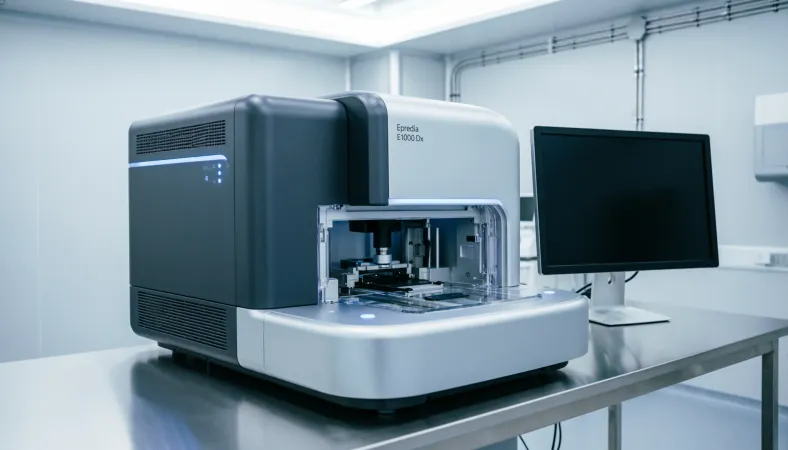
PHC Subsidiary Secures Regulatory Approval for Epredia E1000 Dx in Japan
A subsidiary of PHC Holdings Corporation, headquartered in Tokyo’s Chiyoda-ku, has officially announced that it has obtained manufacturing and sales approval in Japan for the Epredia “E1000 Dx Digital Pathology Solution,” hereafter referred to as E1000 Dx, as a Class II medical device, marking a significant milestone in the advancement of digital pathology solutions within the country while reinforcing PHC’s long-term commitment to improving diagnostic precision and healthcare efficiency, with commercial sales of the system scheduled to begin on April 16, 2026
Addressing Rising Demand in Cancer Diagnostics
Epredia, a key entity within the PHC Group, has established itself as a leader in anatomical pathology, particularly in the early detection and diagnosis of cancer, guided by its core philosophy of enhancing precision in cancer diagnostics, and as global cancer incidence continues to rise, pathology laboratories are facing mounting pressure to process an increasing volume of diagnostic samples while maintaining accuracy and efficiency, creating an urgent need for advanced technological solutions that can streamline workflows, reduce operational costs, and enable faster turnaround times without compromising diagnostic quality, especially in Japan where healthcare systems are grappling with both an increasing number of cancer cases and structural workforce challenges
Challenges in Japan’s Pathology Landscape
In Japan, pathology laboratories play a crucial role in supporting oncological diagnosis, yet the sector faces a notable shortage of qualified pathologists, compounded by uneven regional distribution that limits access to specialized expertise in certain areas, thereby creating disparities in diagnostic capabilities and patient outcomes, and as the number of pathology specimens continues to grow, there is a pressing need for digital tools that can assist pathologists in managing workloads more effectively, improving collaboration across regions, and ensuring consistent diagnostic standards, making the introduction of solutions such as the E1000 Dx particularly timely and strategically important for the Japanese healthcare ecosystem
Overview of the E1000 Dx Digital Pathology Solution
The E1000 Dx has been designed as a comprehensive digital pathology solution that integrates seamlessly with existing laboratory infrastructure, including both hardware and software systems, thereby minimizing the need for extensive upgrades while enabling laboratories to transition smoothly into digital workflows, and at the core of the system is an automated, high-speed whole-slide imaging scanner that works in conjunction with a medical-grade display and advanced image management and visualization software, collectively enabling the system to generate high-resolution digital images of tissue samples with exceptional clarity and accuracy, with the capability to process up to 1,000 slides in a single run, making it highly suitable for high-volume laboratory environments
Advanced Features Enhancing Workflow Efficiency
One of the defining features of the E1000 Dx is its algorithm-driven sample detection functionality, which accurately identifies the location of tissue samples on slides, significantly reducing scanning time and improving overall throughput, while the system’s dual-stage design further enhances operational efficiency by optimizing slide handling processes and minimizing downtime between scanning cycles, thereby ensuring a more streamlined workflow within pathology laboratories, and in addition to these features, the system incorporates an automated quality control mechanism that performs focus quality checks on scanned images, ensuring that pathologists receive consistently high-quality digital outputs for review, which not only reduces the likelihood of diagnostic errors but also minimizes the need for repeat scans, ultimately contributing to both time and cost savings
Supporting Pathologists with High-Resolution Imaging
The high-resolution imaging capabilities of the E1000 Dx enable pathologists to examine digital slides with a level of detail comparable to, or in some cases exceeding, traditional microscopy, thereby facilitating more accurate and efficient diagnostic decision-making, while also enabling remote access and collaboration among specialists, which is particularly beneficial in regions with limited access to experienced pathologists, and by reducing the physical handling of slides and enabling digital storage and retrieval, the system also contributes to improved laboratory organization and data management, further enhancing productivity and supporting the broader transition toward digital healthcare environments
Executive Perspective on the Approval
Nobuaki Nakamura, Senior Managing Executive Officer and Head of the Diagnostics & Life Sciences Domain at PHC Holdings Corporation, as well as President and CEO of PHC Corporation, highlighted the significance of this regulatory milestone by noting that the E1000 Dx had previously been introduced in Europe in 2024 as an in vitro diagnostic medical device and subsequently received FDA 510(k) clearance in the United States in 2025, demonstrating its global credibility and technological robustness, and he expressed satisfaction that the solution has now secured regulatory approval in Japan as a Class II pathology whole-slide image diagnostic support device, enabling its use in clinical settings across the country, while emphasizing the company’s commitment to leveraging this approval to enhance diagnostic workflows in Japan and ultimately improve patient care outcomes through more efficient and accurate pathology services
Global Presence and Expertise of Epredia
Epredia operates as a member of the PHC Group and has built a strong reputation over more than 85 years as a pioneer and innovator in the field of anatomical pathology, consistently delivering solutions that support precise cancer diagnosis through a portfolio of well-established brands including Erie, Menzel, Microm, Shandon, and Richard Allan, and since its formation in 2019 following the acquisition of the pathology business of Thermo Fisher Scientific by PHC Holdings Corporation, the company has expanded its global footprint, employing approximately 1,200 professionals across manufacturing facilities located in the United States, the United Kingdom, Italy, France, and China, thereby ensuring a strong international presence and the ability to serve healthcare providers worldwide
PHC Group’s Broader Healthcare Vision
The PHC Group, led by PHC Holdings Corporation, operates as a global healthcare organization with a mission to create new value for individuals seeking better health and to contribute to the development of a more prosperous society, and through its diverse portfolio of subsidiaries, including PHC Corporation, Ascensia Diabetes Care Holdings, Epredia Holdings, LSI Medience Corporation, WeMEX Corporation, and Mediford Corporation, the group is actively engaged in the development, manufacturing, and delivery of products and services across key areas such as diabetes management, healthcare solutions, and diagnostics and life sciences, and with consolidated revenue reaching 361.6 billion yen in fiscal year 2024 and a presence in more than 125 countries and regions, the PHC Group continues to play a significant role in advancing global healthcare innovation
Driving the Future of Digital Pathology in Japan
The approval and upcoming launch of the E1000 Dx in Japan represent a pivotal step in accelerating the adoption of digital pathology technologies within the country, addressing critical challenges such as workforce shortages, increasing diagnostic demand, and the need for greater efficiency in laboratory operations, while also aligning with broader trends toward digital transformation in healthcare, and by enabling faster, more accurate, and more scalable diagnostic processes, the E1000 Dx is poised to support healthcare providers in delivering improved patient outcomes, reinforcing PHC’s position as a key contributor to innovation in the global diagnostics landscape and underscoring the growing importance of digital solutions in shaping the future of cancer diagnosis and care
Source link:https://www.businesswire.com/