
Komatsu Ltd. has announced that its wholly owned subsidiary, Komatsu America Corp., has entered into an agreement to acquire the remanufacturing business assets of SRC of Lexington, Inc., a Kentucky-based company recognized for its long history of supplying remanufactured components and parts for construction and mining equipment across the United States. The move represents another step in Komatsu’s long-term strategy to strengthen its circular business model, expand customer support capabilities in North America, and reinforce supply stability for essential machine components.
The transaction remains subject to customary closing conditions and approvals, with completion anticipated by the end of February 2026. While strategically significant, Komatsu indicated that the acquisition is not expected to materially affect its consolidated financial results. Instead, the value of the deal lies in operational alignment, improved service responsiveness, and the continued scaling of Komatsu’s remanufacturing—or “Reman”—business, which has become a cornerstone of the company’s sustainability and lifecycle support initiatives.
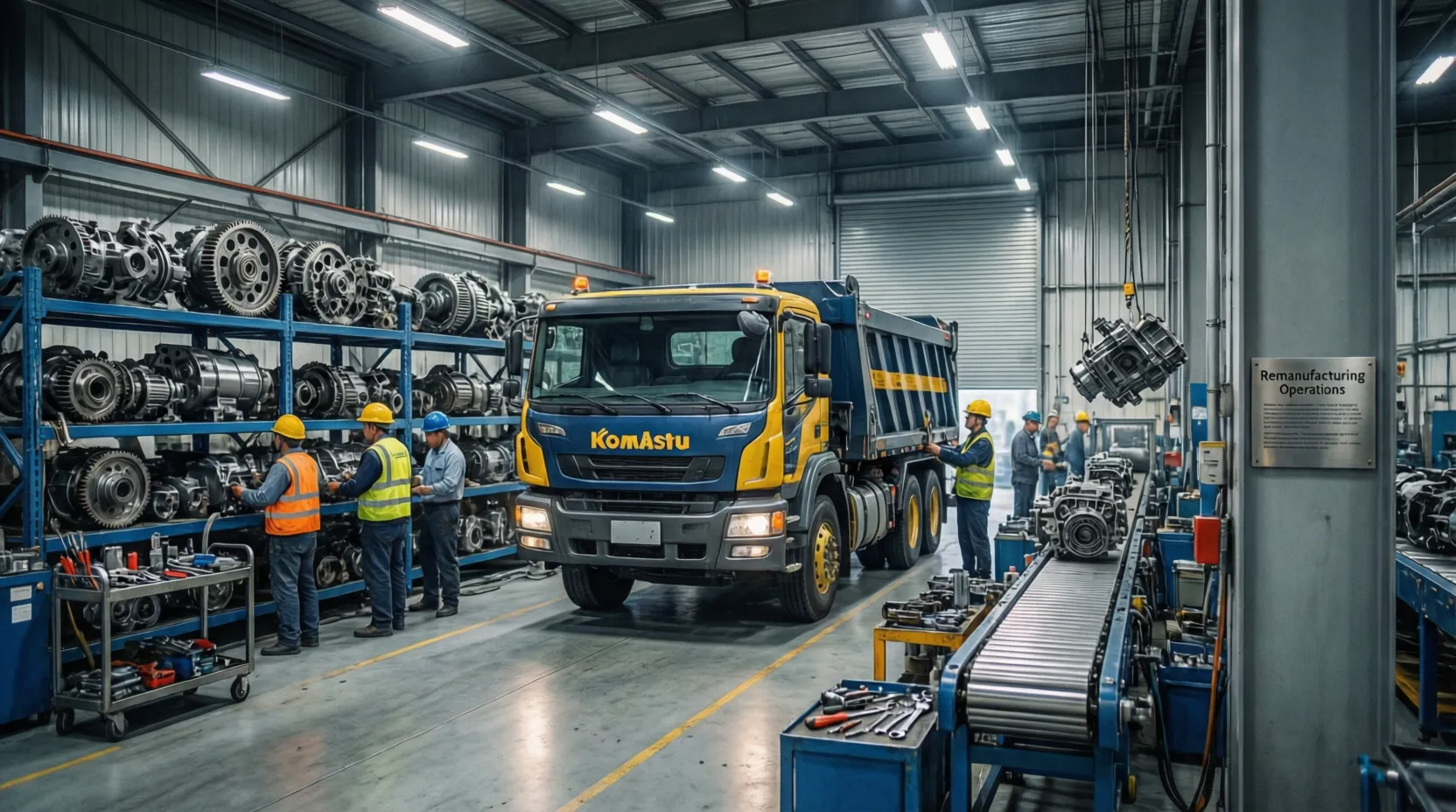
Remanufacturing plays a central role in Komatsu’s approach to resource efficiency and environmental stewardship. Through its Reman operations, the company retrieves used and end-of-life components from construction and mining equipment, carefully restores them to like-new performance standards at specialized facilities, and reintroduces them into the market with quality assurance comparable to newly manufactured parts. This process not only reduces material consumption and waste but also lowers costs and lead times for customers, delivering measurable economic and environmental benefits.
Komatsu’s internal engineering expertise—particularly in high-value components such as engines, transmissions, hydraulic systems, and drivetrain assemblies—enables the company to maintain strict quality control throughout the remanufacturing process. As a result, customers gain access to reliable, performance-certified components that extend equipment life cycles while reducing total ownership costs. At the same time, the reuse of core materials contributes to lower carbon emissions and improved resource utilization, aligning with broader global sustainability goals across the heavy equipment industry.
Demand for remanufactured solutions has grown steadily over the past decade, driven by the expanding installed base of construction, quarrying, and mining machinery worldwide. Between fiscal year 2010 and fiscal year 2024, Komatsu reported that transaction volumes within its Reman business increased approximately fourfold—an indicator of both rising customer acceptance and the company’s successful investment in remanufacturing infrastructure. This growth trajectory has positioned Reman as a strategic business pillar supporting Komatsu’s long-term profitability and environmental commitments.
Naoyuki Sakurai, President of Komatsu’s Parts & Reman Promotion Division, emphasized the importance of the acquisition in advancing these objectives. He noted that integrating SRC of Lexington’s operations directly into Komatsu’s organizational structure will enhance responsiveness to customer requirements, improve regional supply stability, and accelerate the global expansion of the company’s circular business framework. Bringing the Lexington facility in-house is expected to streamline coordination across engineering, logistics, and service functions while ensuring consistent quality and delivery performance.
From SRC Holdings Corp.’s perspective, the agreement also represents continuity and opportunity. Tim Stack, President of SRC Holdings Corp., described the transaction as a reflection of shared values centered on technical excellence, long-term customer support, and responsible stewardship of employees and community relationships. He highlighted that joining Komatsu will allow the Lexington workforce—backed by more than three decades of remanufacturing expertise—to continue building on its legacy with the benefit of sustained investment, global integration, and expanded growth prospects.
Komatsu’s commitment to remanufacturing dates back several decades and has evolved into a comprehensive global network. A major milestone occurred in 2005 with the establishment of a remanufacturing facility in Chile designed to support electric dump trucks produced in the United States. This was followed in 2007 by another facility in Indonesia focused on servicing components manufactured in Japan. These early international investments laid the groundwork for a two-pillar global Reman structure capable of supporting equipment fleets across multiple continents.
By 2025, Komatsu’s remanufacturing footprint had expanded to 45 locations spanning 16 countries, reflecting both organic growth and targeted capacity development in key mining and construction markets. This network enables the company to provide localized service while maintaining standardized global quality practices, ensuring that customers receive consistent performance regardless of region. The addition of the Lexington, Kentucky facility further strengthens this network, particularly within North America—one of the world’s largest and most technologically advanced markets for heavy equipment.
North America’s mining, quarrying, and construction sectors have experienced notable equipment fleet expansion since 2010, increasing demand for cost-effective maintenance and lifecycle extension solutions. Customers and distributors in the region have expressed strong interest in expanded remanufacturing capacity that can reduce downtime, improve parts availability, and shorten turnaround times. Incorporating SRC of Lexington’s established operations directly into Komatsu’s Reman ecosystem addresses these needs while positioning the company for future growth tied to infrastructure investment, energy transition projects, and resource development.
Beyond immediate operational benefits, the acquisition also underscores broader industry trends toward circularity and sustainability. Heavy equipment manufacturers are under growing pressure to reduce environmental impact across the full product lifecycle—from raw material extraction and manufacturing to operation, maintenance, and end-of-life management. Remanufacturing provides a practical pathway to achieving these goals by minimizing waste, conserving materials, and lowering greenhouse gas emissions associated with producing entirely new components.
For customers, the advantages extend beyond sustainability metrics. Remanufactured parts typically offer lower acquisition costs compared with new components, while maintaining equivalent reliability and warranty coverage. Faster availability can also reduce costly machine downtime in mining and construction operations where productivity is tightly linked to equipment uptime. These combined benefits explain why remanufacturing has shifted from a niche service to a mainstream expectation within modern equipment support strategies.
Komatsu’s acquisition of SRC of Lexington therefore represents more than a simple expansion of physical capacity. It reflects the company’s intention to deepen integration across its value chain, strengthen relationships with regional customers, and accelerate progress toward a more sustainable industrial ecosystem. By combining SRC’s specialized remanufacturing expertise with Komatsu’s global engineering resources, digital service capabilities, and distribution network, the partnership is expected to deliver enhanced value to equipment owners throughout North America and beyond.
Looking ahead, Komatsu continues to position remanufacturing as a long-term driver of both environmental performance and business resilience. As equipment fleets age and sustainability expectations rise, demand for high-quality remanufactured components is likely to grow further. Investments such as the Lexington acquisition demonstrate how the company is proactively scaling its infrastructure to meet this demand while reinforcing its commitment to circular economy principles.
With the anticipated closing in early 2026, the integration of SRC of Lexington into Komatsu’s operations will mark another milestone in the evolution of the company’s global Reman strategy. Strengthened regional support, expanded supply capacity, and continued focus on lifecycle value creation are expected to define the next phase of growth—ensuring that remanufacturing remains a central element of Komatsu’s mission to support customers, conserve resources, and build a more sustainable future for the construction and mining industries.
Source Link:https://www.komatsu.jp/en/newsroom/2026/20260205