

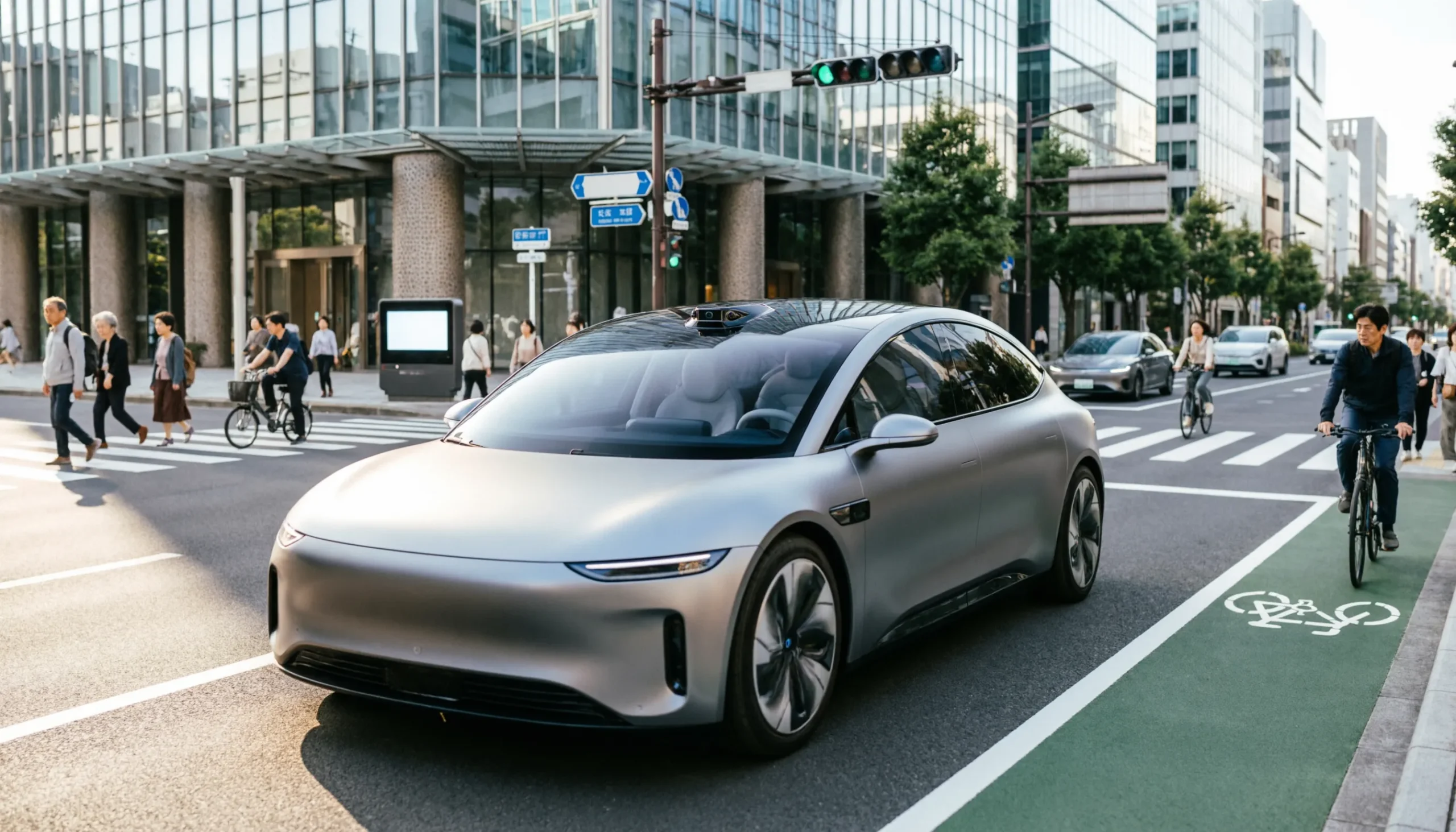
Helm.ai, a leading provider of advanced artificial intelligence software for autonomous driving and robotics automation, has announced a significant expansion of its production-ready autonomous driving platform, Helm.ai Driver, positioning the company at the forefront of scalable next-generation vehicle autonomy; this vision-only software stack is engineered to transition seamlessly from advanced Level 2+ driver assistance systems to Level 4 urban autonomy, offering automotive manufacturers a unified, future-proof pathway toward increasingly sophisticated automated driving capabilities; the announcement underscores Helm.ai’s strategic focus on delivering a commercially viable, certifiable, and hardware-efficient autonomy solution capable of operating without reliance on high-definition maps or lidar sensors while maintaining human-like performance in complex urban traffic environments.
Production-Ready Vision-Only Architecture for Scalable Autonomy
At the core of Helm.ai Driver lies the company’s proprietary Factored Embodied AI architecture, a level-agnostic foundation model designed to operate consistently across varying degrees of automation; unlike traditional autonomy stacks that require entirely different software frameworks for Level 2+, Level 3, and Level 4 systems, Helm.ai’s architecture enables original equipment manufacturers to deploy advanced Level 2+ systems immediately while preserving the same underlying software foundation for future Level 3 “eyes-off” and Level 4 fully autonomous capabilities; this continuity significantly reduces development redundancy, lowers validation costs, and streamlines regulatory certification processes as vehicle hardware platforms and legislative approvals evolve over time; by decoupling autonomy performance from dependence on expensive sensor arrays and pre-mapped environments, Helm.ai introduces a vision-first paradigm that leverages advanced neural networks to interpret the driving environment in real time, enabling mass-market scalability on practical automotive compute platforms.
Real-World Demonstration in Redwood City
To validate the maturity of the expanded system, Helm.ai released a demonstration video showcasing Helm.ai Driver operating autonomously within the urban landscape of Redwood City; the footage highlights the software stack executing complex left and right turns at signalized and unsignalized intersections, complying accurately with dynamic traffic light patterns, and interacting smoothly with other road users including vehicles, cyclists, and pedestrians; the demonstration was conducted under standard production-intent testing protocols, with a safety driver present to supervise operations in accordance with established autonomous vehicle validation procedures; the system’s performance in real-world city traffic illustrates its readiness for integration into OEM production pipelines and underscores the robustness of its perception and policy modules in unpredictable urban conditions.
Overcoming the Industry’s “Data Wall” Challenge
The automotive autonomy sector is increasingly confronting what industry experts describe as the “Data Wall,” a threshold at which incremental performance improvements demand exponentially larger volumes of rare, edge-case driving data; traditional end-to-end pixel-to-control neural networks require vast annotated datasets gathered from millions of miles of real-world driving to handle infrequent yet safety-critical scenarios; this brute-force approach not only escalates development costs but also introduces certification challenges, as monolithic models function as opaque “black boxes” that provide limited interpretability for regulatory bodies assessing compliance with functional safety standards; Helm.ai Driver directly addresses this bottleneck by adopting a factored architectural approach that separates perception from decision-making, thereby improving both data efficiency and transparency.
Factored Embodied AI: Interpretable Layers for Certification
Helm.ai’s Factored Embodied AI framework divides the autonomy problem into two interpretable layers: Perception and Policy; the Perception layer transforms raw sensor input into richly structured semantic segmentation and three-dimensional geometric representations of the driving scene; this process converts pixels into meaningful environmental abstractions such as lane boundaries, traffic participants, road signs, and spatial relationships; the Policy layer then consumes this semantic geometry rather than raw imagery, enabling the neural planner to reason about traffic rules, road topology, and dynamic agent behavior with significantly enhanced clarity and data efficiency; by structuring the autonomy pipeline in this manner, Helm.ai enhances traceability and auditability, key prerequisites for ISO 26262 functional safety certification at Level 3 and Level 4; the architecture’s transparency offers automotive OEMs a clear validation pathway, mitigating the certification barriers that have historically slowed high-level autonomy deployment.
Transforming Unit Economics of Autonomous Development
According to Vladislav Voroninski, founder and CEO of Helm.ai, the industry has reached a tipping point where brute-force data collection is no longer commercially sustainable for high-end autonomous systems; Helm.ai Driver fundamentally shifts the unit economics of autonomy by delivering a single scalable software brain that powers advanced Level 2+ applications today while serving as the core intelligence for Level 3 and Level 4 capabilities tomorrow; this continuity reduces duplicated R&D investment, accelerates time-to-market, and supports mass-production viability on cost-effective compute hardware; by eliminating dependence on lidar and HD mapping infrastructure, Helm.ai further reduces bill-of-material costs, making advanced autonomy accessible to a broader segment of the global automotive market rather than restricting it to premium niche vehicles.
Orders-of-Magnitude Efficiency Through Deep Teaching™
One of the most notable technical breakthroughs behind Helm.ai Driver is the dramatic reduction in required real-world driving data; whereas conventional urban autonomy programs often demand millions of miles of recorded driving and billions of dollars in capital expenditure, Helm.ai reports that its planner achieved urban driving maturity using only approximately 1,000 hours of real-world data; this leap in efficiency is enabled by Deep Teaching™, Helm.ai’s proprietary unsupervised learning methodology that allows neural networks to learn from vast quantities of non-driving visual data without costly manual annotation; by leveraging internet-scale datasets, the system internalizes visual patterns, environmental structures, and spatial reasoning concepts that transfer effectively to real-world driving tasks; this approach reduces reliance on curated automotive-specific datasets and accelerates training cycles.
Semantic Simulation and Infinite Geometric Scenarios
Complementing Deep Teaching™ is Helm.ai’s semantic simulation framework, which allows the system to train on virtually unlimited geometric configurations without rendering photorealistic imagery; traditional simulation pipelines consume significant computational resources generating high-fidelity pixel-level scenes; in contrast, Helm.ai trains directly on semantic geometry, focusing on the structural essence of driving environments rather than superficial visual details; this abstraction significantly lowers computational overhead while enabling exposure to a far broader distribution of potential traffic scenarios; by concentrating on geometry and semantics, the platform bypasses many of the cost and time constraints that have historically hindered scalable autonomous vehicle development; the combination of semantic simulation and factored modeling provides a powerful multiplier effect in data efficiency, breaking through the limitations imposed by the industry’s Data Wall.
Zero-Shot Generalization Across Geographies
A defining benchmark for production-grade autonomous systems is their ability to generalize to previously unseen environments without extensive manual tuning or reliance on HD maps; Helm.ai demonstrated this capability by deploying Helm.ai Driver in Torrance within the greater Los Angeles metropolitan area; despite having no prior training on the specific street layouts or traffic configurations of the region, the system successfully performed zero-shot autonomous steering, adapting dynamically to local road geometry and traffic behavior; this achievement underscores the strength of the factored architecture and the robustness of its semantic understanding; zero-shot generalization eliminates the need for city-by-city data collection campaigns and minimizes geographic geofencing, empowering OEM partners to deploy scalable autonomy features globally with significantly lower operational overhead.
Enabling the Transition from Level 2+ to Level 4
Helm.ai Driver’s level-agnostic design positions it uniquely within the competitive autonomy landscape; automotive manufacturers can integrate the system into advanced driver assistance platforms immediately, delivering high-end Level 2+ functionality such as hands-on highway automation and urban assistance; as hardware sensors, compute capabilities, and regulatory approvals mature, the same core software can be elevated to Level 3 eyes-off driving and eventually to Level 4 full autonomy in defined operational domains; this phased evolution ensures continuity in validation data, preserves engineering investment, and supports long-term strategic roadmaps; by avoiding disruptive software overhauls at each autonomy milestone, Helm.ai provides OEMs with a stable technological backbone for decade-long product planning cycles.
A Practical Path Toward Certified Urban Autonomy
The expanded Helm.ai Driver platform reflects a broader industry shift toward scalable, certifiable, and economically viable autonomy solutions; by combining vision-first perception, interpretable policy reasoning, Deep Teaching™, and semantic simulation, Helm.ai addresses the dual imperatives of safety certification and commercial scalability; the demonstration in Redwood City, along with zero-shot validation in Torrance and the wider Los Angeles region, illustrates tangible progress toward production-ready urban autonomy; as regulatory frameworks evolve and consumer acceptance of higher-level automation increases, Helm.ai’s unified architecture offers automotive OEMs a pragmatic route from today’s supervised systems to tomorrow’s fully autonomous mobility; in redefining the economics and technical architecture of autonomous driving, Helm.ai positions itself as a catalyst for the next era of intelligent transportation, bridging the gap between experimental prototypes and globally deployable, mass-market autonomous vehicles.
Source Link:https://www.businesswire.com/