
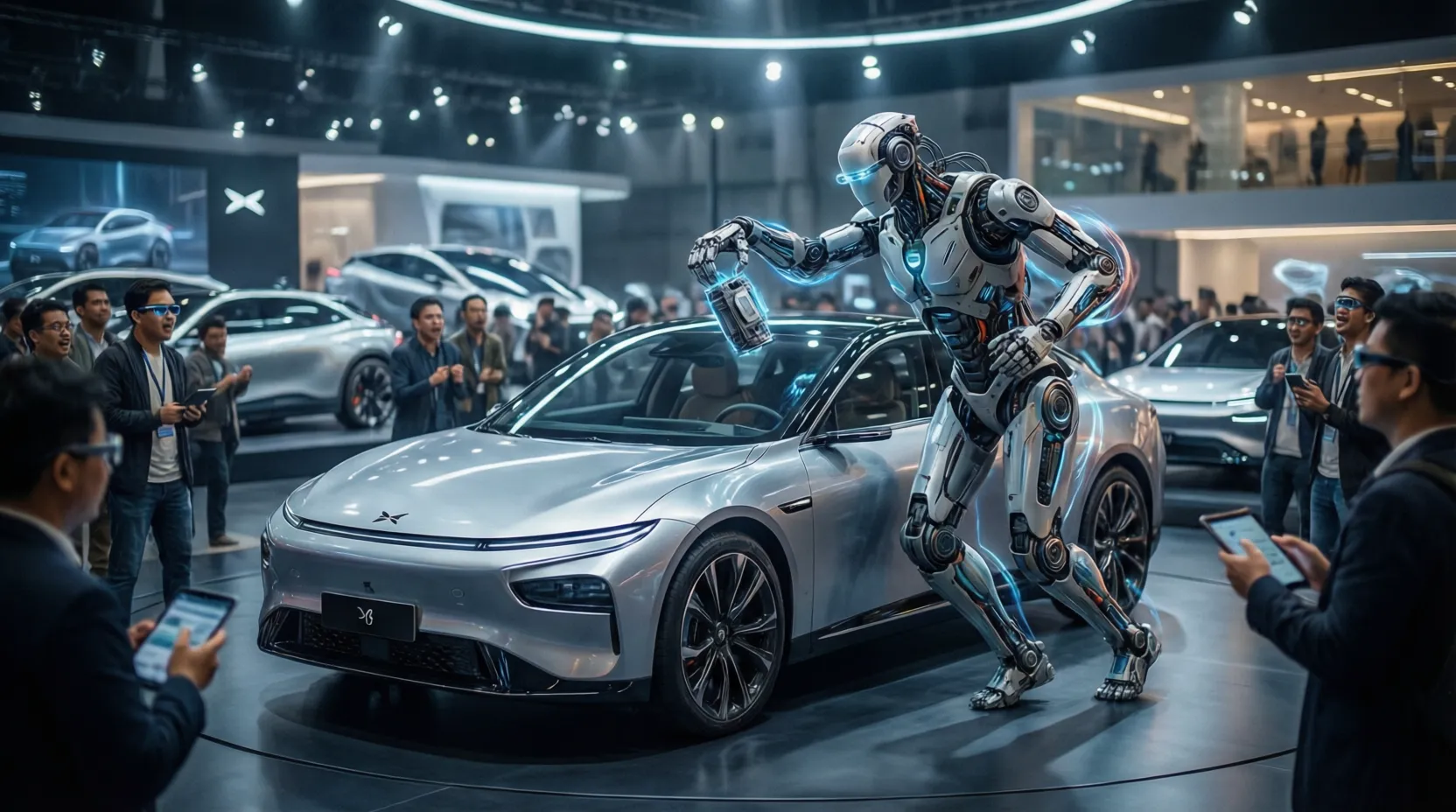
XPENG, a globally recognized mobility technology company driven by artificial intelligence, has marked a significant milestone in its Southeast Asian journey with its debut at the 2026 Indonesia International Motor Show (IIMS). At the event, the company unveiled the Next P7, its latest flagship AI-powered sedan, while also presenting a broader strategic vision focused on transforming transportation from the current Digital AI era into what it describes as the emerging Physical AI era.
The showcase not only highlighted XPENG’s newest technological achievements but also reinforced the company’s long-term commitment to Indonesia—one of the region’s fastest-growing electric vehicle (EV) markets. Since officially entering the Indonesian market, XPENG has recorded steady progress across several critical areas, including vehicle sales, localized production, retail and service network expansion, and the development of next-generation charging infrastructure. These achievements collectively signal the company’s intention to play a sustained and influential role in Indonesia’s evolving mobility landscape.
Rapid Growth and Market Momentum in Indonesia
XPENG’s expansion in Indonesia has been marked by measurable milestones that demonstrate increasing consumer trust and market acceptance. Among the most notable achievements is the strong performance of the XPENG X9, which became the top-selling large electric MPV in Indonesia in December 2025. This accomplishment reflects not only competitive product positioning but also growing confidence among Indonesian consumers in the reliability, performance, and technological sophistication of XPENG vehicles.
On the manufacturing front, the company has made meaningful progress toward localization. More than 1,000 vehicles have already been produced and delivered within the country, underscoring XPENG’s commitment to building a sustainable local presence rather than relying solely on imports. The XPENG G6 Pro has now entered local production, with operational teams accelerating delivery timelines to meet rising customer demand. Local manufacturing is expected to improve supply efficiency, reduce wait times, and contribute to Indonesia’s broader EV industrial ecosystem.
XPENG is also focused on expanding nationwide accessibility. The company plans to extend its footprint to 25 locations across Indonesia by 2026, strengthening customer access to sales, service, and support infrastructure. This retail and service network growth is essential for long-term EV adoption, ensuring that ownership remains convenient and reliable across multiple regions of the country.
Advancing Indonesia’s EV Infrastructure
Beyond vehicle sales and production, XPENG has taken steps to accelerate Indonesia’s EV charging ecosystem. In collaboration with Voltron, the company introduced the country’s first 480 kW ultra-fast charging station, a development that represents a major leap forward in charging speed and convenience.
This high-power charging solution is compatible with XPENG’s G6 and X9 models and is designed to significantly reduce charging times, addressing one of the primary concerns among prospective EV buyers. By investing in infrastructure alongside vehicle deployment, XPENG is helping to create the foundational ecosystem required for widespread EV adoption in Indonesia.
Such initiatives also position XPENG as more than just an automaker. Instead, the company is working to become an integrated mobility technology provider capable of shaping the broader environment in which electric transportation operates.
From Digital AI to the Physical AI Era
A central theme of XPENG’s IIMS presentation was its vision for the Physical AI era—a stage of technological evolution in which artificial intelligence extends beyond screens and software to directly influence real-world movement, perception, and interaction.
At the core of this transformation is XPENG’s self-developed Turing AI chip, which has now entered mass production. The chip enables vehicles to run advanced AI models locally in real time, allowing for faster decision-making, improved autonomy functions, and more natural human–machine interaction. This capability represents a shift from cloud-dependent intelligence toward embedded, responsive systems operating directly within the vehicle.
XPENG’s Physical AI strategy extends well beyond passenger cars. The company is actively developing Robotaxi platforms, humanoid robotics, and flying mobility solutions, each designed with practical real-world deployment in mind. By pursuing innovation across multiple mobility formats, XPENG aims to position itself at the forefront of next-generation intelligent transportation.
The Next P7: Flagship of the AI Mobility Vision
The centerpiece of XPENG’s exhibition was the Next P7, a sleek, minimalist sports sedan that embodies the company’s design philosophy and technological ambitions. The vehicle integrates lighting systems, sensor architecture, and aerodynamic sculpting into a unified exterior form, creating a dynamic yet refined visual identity.
Technologically, the Next P7 stands out for its extraordinary computing capability. Equipped with three Turing AI chips, the sedan delivers a combined 2,250 trillion operations per second (TOPS) of processing power—approximately nine times higher than prevailing industry benchmarks. This immense computational capacity allows the vehicle to support sophisticated local AI models capable of human-like reasoning, smoother intelligent driving behavior, and more intuitive interaction with occupants.
XPENG CEO He Xiaopeng emphasized the broader significance of the model, describing it as more than simply a new car. According to him, the Next P7 represents XPENG’s response to the AI age in both technological substance and conceptual design. He suggested that AI-enabled vehicles can be viewed as one of the most accessible real-world forms of robotics—essentially intelligent machines on four wheels designed to interact seamlessly with people and their environments.
AI Mobility For All and Indonesia’s Smart Mobility Future
The debut of the Next P7 also marked the introduction of XPENG’s “AI Mobility For All” initiative. This program is intended to make Physical AI-powered transportation accessible to everyday users rather than limiting advanced intelligence to premium or experimental platforms.
Indonesia plays a central role in this vision. With a large population, rapid urbanization, and increasing openness to new mobility technologies, the country offers fertile ground for the deployment of intelligent EV solutions. XPENG aims to build a comprehensive smart mobility ecosystem that integrates vehicles, charging infrastructure, AI capabilities, and digital services into a seamless daily experience for Indonesian consumers.
Approaching One Year in Indonesia
As XPENG nears the first anniversary of its Indonesian operations this June, the company reflected on the partnerships that have supported its early growth. Collaboration with organizations such as Erajaya Active Lifestyle has helped accelerate market entry, expand distribution, and strengthen local engagement.
Looking ahead, XPENG intends to deepen these collaborations while continuing to invest in technology, infrastructure, and localized capabilities. The overarching objective is to embed Physical AI mobility into everyday transportation across Indonesia—transforming how people move, interact with vehicles, and experience intelligent technology in daily life.
A Strategic Step Toward the Future of Mobility
XPENG’s debut at the 2026 Indonesia International Motor Show represents more than a product launch. It signals a broader strategic push to redefine mobility through artificial intelligence, localized ecosystems, and infrastructure development.
By combining high-performance EV technology, real-time AI computing, nationwide expansion, and forward-looking innovation across robotics and autonomous systems, XPENG is positioning itself as a key player in the next chapter of global transportation. Indonesia, with its dynamic growth and openness to innovation, stands at the center of that journey.
As the Physical AI era begins to take shape, XPENG’s initiatives suggest a future where intelligent mobility is not a distant concept but an everyday reality—integrated seamlessly into cities, communities, and human life itself.
Source Link:https://www.xpeng.com/