
Morning Rituals and the Seoul Drive
Ride The door of the Hyundai IONIQ 6 N closes with a solid, reassuring thump that speaks to precision engineering. In the crisp pre-dawn air above Seoul, Manfred Harrer, President and Head of Hyundai Motor Group’s R&D division, exhales, watching his breath curl in the morning chill. “What many people don’t realize about Seoul,” he says, “is that just minutes from the city center, you encounter incredible roads and world-class coffee. It’s the perfect environment to think through technical challenges.” For those who have braved the crowded cafés or the caffeinated traffic, the notion of using a morning drive to clear the mind may seem counterintuitive. But Harrer thrives on detail. His chosen café sits high in Seongbuk-gu, offering sweeping views of the Bugaksan-ro Skyway. The climb up tight switchbacks and rhythmic turns allows him to experience elevation changes, cornering dynamics, and the subtle interplay of ride and handling, all before he takes his first sip of flat white. By the time the coffee warms his hands, the drive has already yielded insights and observations for the day ahead.
Precision Driving and Observational Insights
For someone whose to-do list spans continents and disciplines, efficiency is paramount. “It would be easy to let driving slip down the list,” Harrer admits, “but I take every opportunity to get behind the wheel, whether in the morning, at lunch, or on weekends. Even a short drive reveals a lot. Are the seating positions comfortable? Does the ride meet our exacting standards? Every detail matters.” Driving is not merely a convenience for Harrer; it is a tool for continuous observation, a lens through which he evaluates every nuance of vehicle performance. This philosophy of detail extends beyond the driver’s seat into the larger arena of vehicle engineering and development.
Accelerating Hyundai Motor Group’s Electrification Transition
Harrer’s quick pivot to first principles is hardly surprising. With a PhD in vehicle dynamics and over 25 years’ experience spanning chassis development, electronic systems, software integration, and ADAS technologies, his expertise lies in the nexus of theory and applied engineering. He oversees global vehicle development at Hyundai Motor Group, leading more than 12,000 engineers at the Namyang R&D Center near Seoul. Yet he considers this role the most exciting of his career, not because of scale alone, but because of timing. “The industry is undergoing its biggest transformation ever,” Harrer notes. “We are shifting from combustion engines to electrification, from hardware-defined to software-defined vehicles. AI is accelerating development cycles, improving precision, and expanding what’s possible.” Hyundai’s approach is further compounded by market-specific product tailoring and innovative hybrid or Extended Range EV technologies, illustrating both the breadth and complexity of modern automotive challenges.
Hyundai IONIQ 6 N: Performance Engineering Without Compromise
When the IONIQ 6 N debuted at the 2025 Goodwood Festival of Speed, Harrer positioned it as a performance EV combining advanced battery technology, efficient aerodynamics, powerful drivetrains, and sophisticated suspension systems to redefine engineering benchmarks. The goal was not simply high-performance metrics on a track, but achieving them while preserving everyday usability. Harrer describes this as “thoughtful but impactful changes” that elevate performance without compromising comfort or practicality. From the café, he outlines revisions to suspension settings, structural stiffness, steering calibration, and AWD system dynamics, emphasizing that certain components, such as stroke-sensing electronically controlled suspension dampers, were selected to improve ride quality and handling responsiveness. The result is a versatile package capable of inspiring confidence on both racetrack and open road, embodying Hyundai’s detail-driven, performance-focused engineering philosophy.
Detail-Driven Development Across the Group
Harrer’s philosophy extends well beyond halo models. As head of R&D, he sets the strategic direction for Hyundai, Kia, and Genesis brands while ensuring that teams responsible for individual platforms pursue granular improvements to driving dynamics. His approach encourages experimentation with small, high-impact adjustments—revisions to suspension geometry, torque vectoring systems, steering responsiveness, or chassis rigidity—that collectively enhance the driver experience. It is a blend of technical rigor and creative freedom, balancing efficiency with innovation. Harrer’s insistence on detail ensures that even minor improvements in ride quality, weight distribution, or handling consistency are incorporated into vehicles, underscoring a comprehensive engineering vision that values both global scale and micro-level precision.
A Global Vision Grounded in Tangible Details
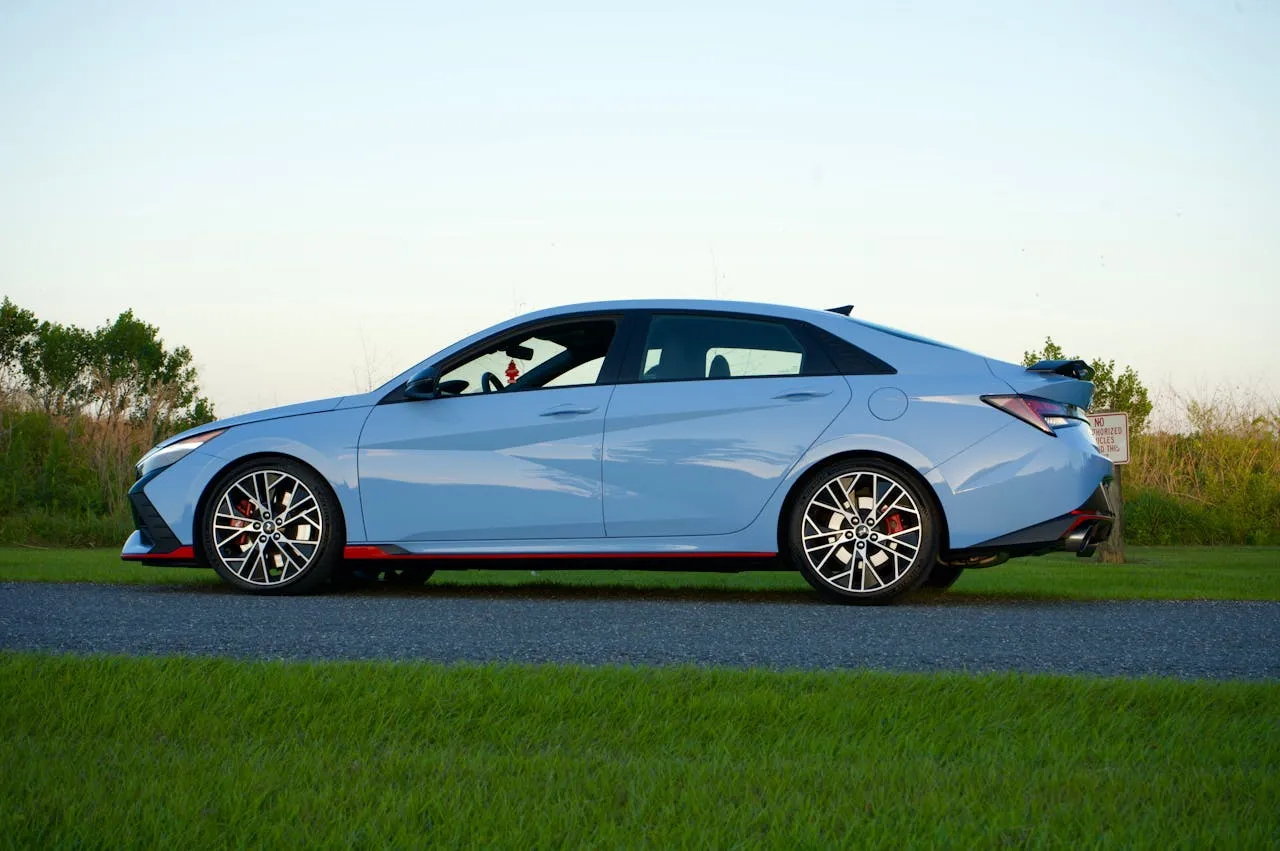
Even in the café car park, Harrer’s attention to engineering details is evident. He points out the swan-neck rear wing, the 20-inch perforated alloy wheels, and the depth of the shimmering Performance Blue Pearl paint on the IONIQ 6 N. Beyond aesthetics, these features contribute to aerodynamic efficiency, handling stability, and visual impact. Harrer observes that EV platforms provide unprecedented scope for innovation. Strategic battery placement lowers the center of gravity, bespoke tire selection enhances handling predictability, and advanced torque vectoring sharpens agility. Performance EVs create opportunities to optimize energy efficiency, driving dynamics, and safety simultaneously. This approach, Harrer emphasizes, is as much about long-term strategic transformation as it is about immediate tactile feedback—bridging conceptual engineering with the real-world pleasure of driving.
Balancing Innovation with Driver Experience
Harrer’s dual focus on strategic foresight and tactile engineering mirrors the duality of the IONIQ 6 N itself. He can discuss AI-driven development, electrification trends, and global product strategies with the same fluency as chassis tuning, steering calibration, and suspension refinement. For Harrer, technology exists to serve human experience: precise handling, confidence-inspiring dynamics, and daily usability remain the core of automotive engineering, even as electrification and AI redefine possibilities. EV platforms, he notes, allow engineers to rethink performance entirely—lowered centers of gravity, immediate torque delivery, regenerative braking systems, and active suspension dynamics create vehicles that are simultaneously exhilarating and practical.
AI and Electrification: The Dawn of a New Engineering Era
“There has never been a more exciting time to be an automotive engineer,” Harrer says as he settles into the driver’s seat. AI is transforming simulation and development, reducing time from concept to road-ready prototype, while electrification is redefining performance envelopes. Batteries are no longer constraints but opportunities, enabling engineers to balance power, efficiency, and handling in ways impossible with traditional combustion platforms. Harrer emphasizes that these tools allow for innovation without compromising core driving values. Autonomous systems, predictive energy management, and torque-vectoring algorithms are not mere add-ons; they are integral to delivering a coherent, driver-centric performance experience.
The Constant of Driving Pleasure
Harrer closes the door of the IONIQ 6 N with the same measured thud that started the day, a final nod to engineering consistency. Yet amidst all the technological transformation, one principle remains unwavering: driving pleasure matters most. Early mornings in Seoul, tight switchbacks, sweeping vistas, and a carefully crafted flat white serve as reminders that, at its core, automotive engineering exists to connect humans with the road. Harrer believes that true insight comes from getting behind the wheel, observing, and feeling. It is in the minutiae—the seat adjustment, steering feedback, suspension articulation, and tire grip—that innovation meets experience. While AI, electrification, and software-defined platforms redefine the industry, these tactile truths endure.
Engineering with Humanity
Manfred Harrer embodies a rare combination of technical mastery, global perspective, and sensory awareness. His philosophy extends from the macro scale of global EV strategy to the micro scale of how a car feels on a winding Seoul hill. The Hyundai IONIQ 6 N exemplifies this approach, balancing cutting-edge performance engineering with everyday usability. In Harrer’s world, no detail is too small, no innovation too large, and no drive too short to deliver insight. The industry may be evolving at unprecedented speed, but one constant remains: the thrill of driving, meticulously engineered, experienced firsthand, and appreciated in every turn of the wheel.
Source Link:https://www.hyundai.com/